Sep 14, 2026
Build a commercially strong gel polish collection with ISAYNAIL, from finish selection and shade development to private label manufacturing, testing, packaging, and launch.
For a successful private label range, we recommend a structured process: define the target customer, select complementary Types of Gel Polish Finishes: A Collection Guide for Private Label Brands, develop a balanced shade architecture, verify application and curing performance, complete regulatory documentation, and launch with consistent merchandising. Whether you are creating your first collection or expanding an established nail brand, working with an experienced Gel Polish Manufacturer such as ISAYNAIL helps reduce formulation risk, improve batch consistency, and turn finish trends into a practical product portfolio.
!
A finish is more than a visual effect. It influences application behavior, curing requirements, retail positioning, photography, salon performance, and repeat purchase potential.
Before requesting samples, we suggest answering five questions:
Who will use the product?
A professional nail technician may prioritize self-leveling, pigment concentration, and removal performance. A home user may value easy application, low odor, forgiving brush control, and simple curing.
What price segment are you targeting?
Mass-market, mid-range, and professional collections require different packaging, pigment systems, brush specifications, and quality-control budgets.
Which lamp systems will customers use?
LED and UV/LED lamps vary in wavelength, power output, and curing time. The recommended cure schedule must be validated with the final formula, bottle, and lamp system.
What visual identity should the collection communicate?
A minimalist brand may focus on cream, sheer, and cat-eye finishes, while a trend-led brand may need chrome, glitter, reflective, and magnetic effects.
Which markets will receive the products?
Ingredient restrictions, labeling rules, safety assessments, responsible-person requirements, and claims vary by market. We advise confirming compliance before mass production.
This initial positioning prevents a common problem: ordering many attractive samples that do not form a coherent or profitable collection.
The most effective collections usually combine dependable everyday finishes with a smaller number of high-impact trend products. The following structure gives private label brands a practical starting point.
Cream gel polish is the foundation of most salon collections. It provides opaque, even color without visible shimmer or texture.
Best for:
Important development factors include pigment dispersion, opacity in one or two coats, leveling, brush drag, and edge shrinkage. Highly pigmented white and black formulas require careful curing validation because dense pigment loads can affect light penetration.
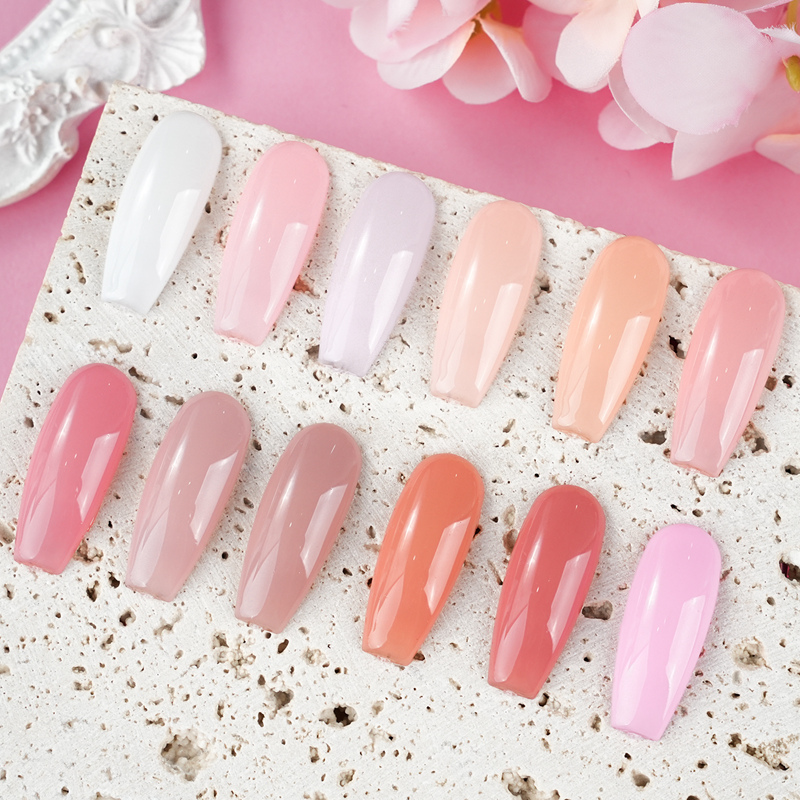
Sheer gel polish creates a translucent “glass nail” or syrup effect. Jelly formulas are especially useful for layering over glitter, chrome, blooming designs, and natural nail looks.
Key considerations include:
For a private label brand, a coordinated jelly range can increase the versatility of the entire collection because customers can use the shades alone or as layering colors.
Shimmer gel polish contains fine reflective particles that create a soft glow. Pearl finishes usually have a more uniform, polished reflection.
The particle size and dispersion system influence:
We recommend testing samples after storage in different orientations. A formula that looks attractive immediately after filling may show pigment settling or uneven re-dispersion after several weeks.
Glitter finishes can contain fine glitter, chunky glitter, holographic particles, or mixed particle sizes. Clear-base glitter products offer flexibility, while pigmented glitter gels provide stronger coverage.
A professional Gel Polish Manufacturer should verify:
For chunky glitter, the top coat must fully encapsulate the surface without excessive bulk. We usually recommend a thin leveling layer followed by a compatible glossy top coat rather than applying one thick coat.
Metallic gel polish uses reflective pigments to create a foil-like appearance. Chrome-effect products may be formulated as gel color, chrome powder systems, or no-wipe top-coat combinations.
These finishes are sensitive to application technique. Brush marks, overworking, and insufficient leveling can reduce the metallic effect. Private label instructions should specify:
Chrome systems also require clear claim language. A “chrome effect” gel polish is not necessarily the same product as a chrome powder kit.
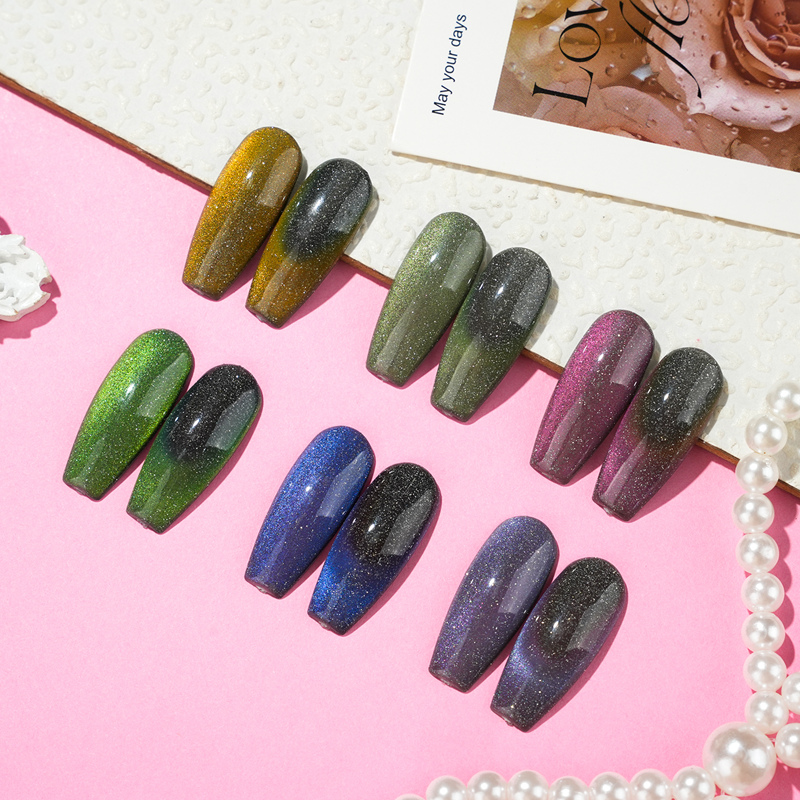
Magnetic gel polish contains magnetic particles that move when a magnet is positioned above the uncured layer. The result can be a stripe, velvet effect, wave, or multi-dimensional cat-eye pattern.
Performance depends on:
We advise brands to provide a magnet with consistent dimensions and to validate the effect using the actual accessory included in the retail package.
Reflective glitter products are designed to appear highly luminous under direct light or flash photography. They are popular for social media content and event-focused collections.
Because reflective particles can create a textured surface, product testing should include:
A small reflective capsule collection can create strong visual interest without making the entire range difficult to manufacture.
Matte gel polish can be created with a matte color formula or a matte top coat. The top-coat approach is generally more flexible because customers can convert glossy colors into matte looks.
Quality checks should focus on:
A matte finish may change the perceived color depth, so shade approvals should include both glossy and matte presentation where relevant.
Once the finish types are selected, we recommend organizing the range into commercial roles instead of choosing shades randomly.
| Collection role | Suggested finish | Typical purpose |
|---|---|---|
| Core essentials | Cream, nude, red, black | Year-round repeat sales |
| Soft fashion | Sheer, jelly, pearl | Natural and layered manicures |
| Premium statement | Chrome, metallic, cat-eye | Higher visual impact and margin |
| Social media driver | Reflective, holographic, chunky glitter | Content creation and seasonal demand |
| Service extension | Matte top coat, glossy top coat, builder-compatible shades | More salon techniques |
| Seasonal capsule | Coordinated shimmer, glitter, or magnetic shades | Limited editions and campaigns |
A practical first launch may contain 12 to 24 color products supported by one base coat, one glossy top coat, and one matte top coat. Expanding to 36 or 48 shades can follow after sell-through data identifies the strongest finish and color families.
We also recommend checking:
A reliable supplier process should move from creative brief to controlled production in defined stages.
Your brief should include:
The more precise the brief, the fewer rounds of sampling will be required.
Sample evaluation should be performed on natural nail tips, standard nail swatches, and salon-style application panels. We recommend recording:
For measurable consistency, record color using a spectrophotometer where available. A brand may set an internal color tolerance, such as a defined Delta E limit, rather than relying only on visual approval.
Gel polish is a chemically active product, so bottle and closure compatibility should not be treated as a cosmetic detail.
Check:
For brush and filling components, dimensional checks can be recorded to 0.01 mm where appropriate. This level of precision is useful for monitoring brush stem fit, wiper openings, and selected packaging tolerances.
The exact test plan depends on the formula and destination market. A credible Gel Polish Manufacturer should provide a documented quality system and batch records rather than relying only on appearance checks.
Common evaluations include:
For technical benchmarking, some brands use recognized methods such as:
These standards may need adaptation because gel polish is a cosmetic nail coating rather than a conventional industrial coating. Any adapted method should be documented in the product specification.
For manufacturing quality, ISO 22716 Good Manufacturing Practices is a relevant reference for cosmetic production. Market-specific requirements, such as the EU Cosmetics Regulation or United States cosmetic regulations, should be reviewed with a qualified compliance professional.
Before mass production, request a pre-production sample using the final pigment lot, bottle, brush, cap, label, and filling process. This step catches problems that laboratory samples may not reveal.
We recommend requiring:
A strong factory protocol may include 100% visual inspection for bottle defects, label placement, cap condition, and obvious filling errors, followed by statistical sampling for performance tests.
When evaluating ISAYNAIL or another private label partner, ask for measurable service commitments rather than broad claims.
Useful supplier questions include:
We recommend putting agreed specifications into a Product Quality Agreement. It should define acceptance criteria for color, viscosity, fill volume, packaging, curing, and defect classification.
This may result from pigment concentration, cure depth, lamp wavelength, top-coat interaction, or display lighting.
Solution: Approve the color after the full application system is cured. Photograph samples under standardized lighting and record the lamp model, wattage, wavelength, coat thickness, and cure duration.
A weak effect can be caused by low magnetic pigment loading, excessive distance, a weak magnet, or curing before the pattern develops.
Solution: Test the formula with the final magnet, define a working distance in the instructions, and validate the effect across thin and medium coats.
Settling is influenced by particle density, base viscosity, and storage temperature.
Solution: Conduct accelerated stability and re-dispersion testing. Evaluate bottles after upright and horizontal storage, and do not approve a formula solely from a freshly mixed sample.
This may indicate excessive coat thickness, insufficient lamp energy, incompatible lamp wavelength, or a formula with poor cure balance.
Solution: Validate the complete system. Specify thin coats, use the recommended lamp, and avoid making universal cure claims without testing different consumer lamp conditions.
Uneven matte appearance can result from contamination, insufficient curing, top-coat thickness variation, or incompatibility with oils and cleansers.
Solution: Test over multiple color families, standardize application thickness, and include surface-preparation instructions in the user guide.
A large assortment increases inventory exposure and complicates color forecasting.
Solution: Start with hero shades and finish variety. A controlled 18-SKU launch with clear merchandising is often easier to sell than a poorly organized 60-SKU catalog.
After product approval, the finish taxonomy should appear consistently across packaging, e-commerce pages, salon displays, and sales materials.
Each product page should show:
For SEO, use natural long-tail phrases such as:
Avoid describing every product as “high quality” without evidence. Specific details such as cure validation, color tolerance, inspection procedures, and documented batch traceability are more persuasive and more trustworthy.
Consider a hypothetical salon brand launching in three markets with a moderate initial budget. Instead of ordering 40 unrelated colors, the brand selected:
The brand then used standardized swatches, approved a master color panel, and required final-batch inspection. The result was a 19-SKU collection with clear use cases: everyday salon services, natural manicures, event looks, and social media designs.
This approach reduced sample confusion, made product photography easier, and allowed the sales team to explain the collection by finish rather than by color alone. The lesson is straightforward: finish architecture can improve both manufacturing control and customer understanding.
We suggest preparing a shared private label development folder containing:
A simple test form should include the date, batch number, lamp model, cure duration, coat count, evaluator, and pass/fail comments. This creates a reliable evidence trail when improvements or complaints must be investigated.
Choosing among the Types of Gel Polish Finishes: A Collection Guide for Private Label Brands should begin with customer needs and commercial positioning, not only trend images. We recommend combining core cream colors with selected sheer, shimmer, glitter, magnetic, metallic, reflective, and matte products. Then move through documented sampling, packaging compatibility, standardized curing tests, stability evaluation, regulatory review, and controlled production.
With ISAYNAIL as your development partner, ask for measurable specifications, retained samples, batch traceability, clear response procedures, and inspection records. A capable Gel Polish Manufacturer should help you manage the complete process from finish selection to retail-ready packaging.
The strongest private label collections are focused, testable, and easy to explain. By applying this Types of Gel Polish Finishes: A Collection Guide for Private Label Brands framework, we can help build a range that looks distinctive on the shelf, performs consistently in the salon, and gives customers a clear reason to purchase again.
Related Products
Nail Art Beauty, Nail Salon, Nail SPA, or Training
Nail Art Beauty, Nail Salon, Nail SPA, or Training
Nail Art Beauty, Nail Salon, Nail SPA, or Training
Nail Art Beauty, Nail Salon, Nail SPA, or Training
Nail Art Beauty, Nail Salon, Nail SPA, or Training
Nail Art Beauty, Nail Salon, Nail SPA, or Training

You can trust us to deliver the best nail products in the market
10 years experience manufacture
Navigation
Navigation
Contact Us
+86 156 2229 8411
802, No. 75, Hanxing Middle Road, Zhongcun Street, Panyu District, Guangzhou City, Guangdong Province, China