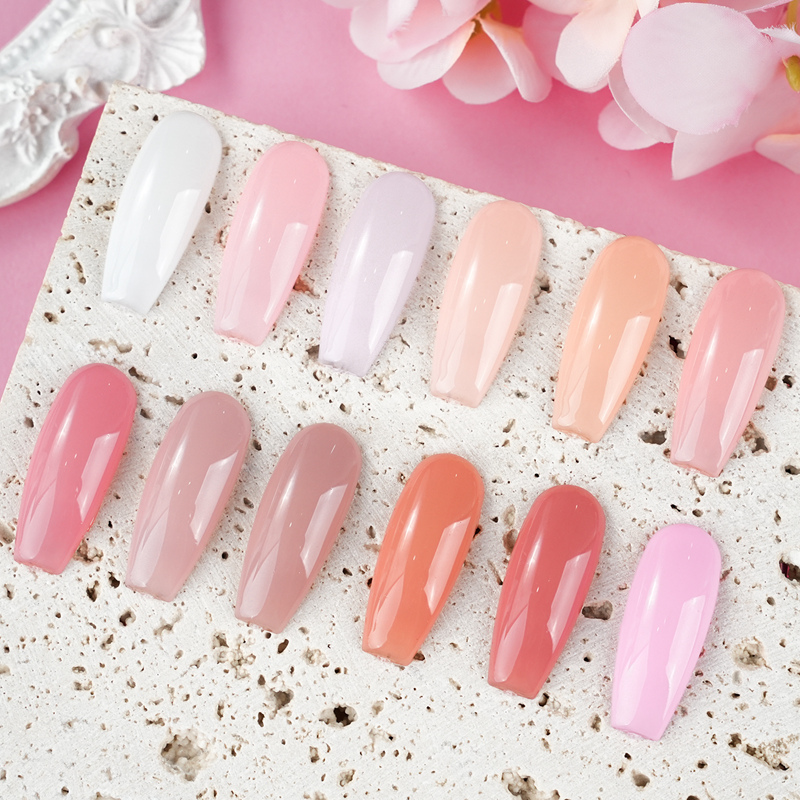
Tinted Top Coat can help a private label gel polish brand solve three common problems: customers want a soft color without a full manicure, salons need a quick way to refresh grown-out nails, and retailers need one product with more than one use. A well-designed tinted top coat for private label gel polish can provide sheer color, shine, and light leveling in one step. However, the product only earns its place when the shade, pigment load, cure performance, and labeling are tested together. This guide explains how to evaluate a custom tinted top coat manufacturer, develop a saleable formula, and choose the right positioning for salons, home users, and nail art customers.
Why a Gel Polish Manufacturer Should Consider a Tinted Top Coat
A traditional clear top coat mainly protects color and creates gloss. A tinted version adds a controlled amount of pigment, so it can work as a finishing layer over a base color, a subtle standalone manicure, or a nail art product. This wider use case can make a small product range easier to understand and can increase the number of manicure looks created from the same bottle.
The commercial opportunity is not a guarantee of success. A tinted top coat can fail if the pigment settles, the color becomes streaky, the layer stays soft after curing, or the shade looks different under salon lighting and daylight. The formula must also remain compatible with the brand's base gel and color gel system.
Customer problems solved by a private label gel polish manufacturer
- Low-maintenance nail users: A sheer pink or beige shade can create a polished appearance without the visual harshness of a fully opaque color.
- Salon refill customers: A translucent layer can soften the contrast between the natural nail growth area and the previous color, although it does not replace professional removal and reapplication.
- Minimalist manicure buyers: One product can provide a light tint and a glossy finish.
- Nail artists: A tinted layer can create a background effect over chrome, glitter, French tips, or layered designs.
- Retailers: A multi-use product can support more content themes, including sheer manicure tutorials, nail art, and quick salon services.
How Tinted Top Coat Differs from Clear Gel Top Coat and Sheer Gel Polish
The term "tinted top coat" is used inconsistently in the market. Before requesting samples, define the product by its intended use.
| Product type | Main function | Typical appearance | Development concern |
|---|---|---|---|
| Clear gel top coat | Protects the color layer and creates gloss or a selected finish | Transparent | Gloss retention, scratch resistance, inhibition layer, and compatibility |
| Tinted top coat | Adds a controlled wash of color while finishing the manicure | Translucent to semi-sheer | Pigment dispersion, streak control, cure depth, and shade consistency |
| Sheer gel polish | Provides a color layer that may be built through multiple coats | Translucent to semi-opaque | Coverage, leveling, removal time, and classification on the label |
| Builder gel or gel overlay | Adds structure, strength, or limited nail architecture | Clear, tinted, or opaque | Viscosity, apex control, heat generation, and structural claims |
A product with enough pigment to provide strong coverage may behave more like a sheer gel polish than a top coat. A product with a low pigment load may be easier to cure and apply, but customers may consider the color too weak. The product name, instructions, claims, and formula should describe the same user experience.
Five Development Tips for a Gel Polish Manufacturer Adding a Tinted Top Coat
1. Define the intended coverage before asking a Gel Polish Manufacturer for samples
Quick answer: Coverage determines pigment load, application behavior, curing risk, and customer expectations.
Operation method:
- Choose a coverage target such as one-coat sheer, two-coat translucent, or three-coat semi-sheer.
- Test each sample on a clear nail tip, a natural-color base, a white base, and a dark color base.
- Record the appearance after one, two, and three thin coats under daylight and salon lighting.
- Measure whether the product levels within the time specified in the technical brief and whether brush marks remain visible after curing.
- Write the coverage description on the packaging. For example, use "buildable sheer tint" rather than "opaque color" if the product is intended to remain translucent.
This method is suitable for brands targeting minimalist manicures, bridal nails, French manicure effects, and quick salon services. A heavily pigmented formula is more suitable when the product is intended to replace a color gel, but it may no longer deliver the handling expected from a top coat.
2. Ask the private label gel polish manufacturer for pigment dispersion and stability data
Quick answer: A stable pigment system reduces shade variation, streaking, settling, and bottle-to-bottle inconsistency.
Operation method:
- Request the pigment or colorant identification and confirm that the ingredients are permitted for the intended sales market.
- Ask how the pigments are dispersed in the gel system and whether the formula requires shaking, rolling, or mixing before use.
- Store samples in the planned packaging and inspect them at defined intervals, such as the initial sample date, 7 days, 14 days, 30 days, and 60 days.
- Check for sediment, color bands, viscosity changes, brush staining, and separation after storage at room temperature and under an agreed accelerated condition.
- Compare the first and last application from the same bottle to identify settling or concentration changes.
Three professional terms are especially important during this discussion: photoinitiator, which starts polymerization when exposed to suitable light; viscosity, which affects flow, leveling, and brush control; and pigment dispersion, which describes how evenly the color particles are distributed through the gel. A supplier should explain these points in technical language that matches the formula and test results, not only with marketing adjectives.
3. Validate curing with the exact lamp and layer thickness
Quick answer: Cure performance depends on the formula, pigment load, layer thickness, lamp output, wavelength, and exposure time, so a generic lamp claim is not enough.
Operation method:
- Test the product with the lamp that the brand plans to recommend, including the lamp model, rated power, wavelength range, and usable age.
- Apply the product in the intended thin layer and in a deliberately thicker layer to identify the margin of safety.
- Check the surface, sidewalls, free edge, and underside for tackiness, wrinkling, movement, or uncured material.
- Repeat the test with the lightest and darkest shades because darker or more heavily pigmented colors can reduce light penetration.
- Set the label curing time only after the formula and lamp combination has passed the supplier's internal testing and the brand's own validation.
Many LED nail lamps are marketed around 365 nm and 405 nm light ranges, but the presence of a number on a lamp box does not prove that every gel formula will cure correctly. The photoinitiator package must be compatible with the lamp's output. A private label brand should avoid telling customers that a product cures in a fixed number of seconds with every lamp unless that claim has been tested across the specific equipment range.
This technique is essential for salon brands and online sellers because under-cured gel can remain chemically reactive. The United States Food and Drug Administration explains that nail products are generally cosmetics, while artificial nail products can contain reactive ingredients and must be used according to their labeling. The British Association of Dermatologists has also warned that skin contact with uncured acrylate products can contribute to allergic contact dermatitis. The practical control is simple: keep uncured gel off the skin, use the recommended layer thickness, and remove product that floods the cuticle before curing.
4. Build a shade system instead of launching random colors
Quick answer: A small, planned shade family is easier to manufacture, explain, photograph, and reorder than a large collection with overlapping colors.
Operation method:
- Start with a clear base tint, a neutral pink, a milky pink, a beige nude, and one seasonal shade such as soft mauve or translucent red.
- Assign each shade a written target using a physical reference tip rather than relying only on a digital color code.
- Evaluate the shade over natural nails, white gel, nude gel, glitter, chrome, and French tips.
- Photograph cured samples in controlled daylight and record the background, camera settings, and number of coats.
- Keep an approved master sample for future production comparison.
For an entry-level private label launch, five coordinated shades can provide more useful combinations than ten unrelated shades. The best shade count still depends on the sales channel, minimum order quantity, and intended market. A salon distributor may prefer neutral shades with repeat-service potential, while a direct-to-consumer brand may test seasonal shades through limited releases.
5. Confirm packaging, labeling, and compliance before approving production
Quick answer: Correct packaging and market-specific labeling protect the product's performance and reduce avoidable regulatory and customer service problems.
Operation method:
- Test the formula in the planned bottle, brush, cap, and wiper because some gel systems can stain components or change viscosity during storage.
- Confirm the net quantity, ingredient declaration, batch or lot identification, responsible company information, warnings, directions, and curing instructions for each target market.
- Keep a safety data sheet where required for the supply chain, while remembering that the safety data sheet does not replace cosmetic labeling requirements.
- Review claims such as "hypoallergenic," "non-toxic," "HEMA-free," "vegan," and "long-lasting" with documentary support. A claim should not be used merely because it is common in competitor listings.
- Approve a production sample, retain a control sample, and define the process for handling shade or viscosity deviations.
In the European Union, cosmetic products are governed by Regulation (EC) No 1223/2009, which includes requirements relating to product safety, responsible persons, product information files, and notification. In the United States, the FDA regulates cosmetic products under the Federal Food, Drug, and Cosmetic Act, while the Modernization of Cosmetics Regulation Act of 2022 added important requirements for cosmetic businesses. Requirements vary by market, so a brand should obtain a current compliance review rather than copy a label from another product.
When Tinted Top Coat Is Worth Adding to a Private Label Gel Polish Line
The product is usually worth testing when the brand already has a compatible base and color system, a clear customer group, and enough content or salon education to explain the difference between sheer tint and opaque color. It is particularly suitable in the following situations:
- Minimalist collections: Neutral tinted top coats support clean, low-contrast manicures and can be promoted with one-coat and two-coat examples.
- Salon express services: A sheer shade may shorten the visual decision process, but the salon must still follow the full preparation and curing procedure.
- French manicure collections: Milky pink or translucent beige can soften the base while preserving the white tip.
- Seasonal nail art: A transparent red, purple, or brown tint can create layered effects over glitter and chrome.
- Beginner-oriented kits: A lower-coverage shade can make application errors less visible than a strongly opaque dark color, although safe skin avoidance and correct curing remain necessary.
The product may not be worth adding if the brand has no lamp guidance, no quality control process, no ability to maintain shade consistency, or no clear difference from its existing sheer gel polish. It is also a poor choice when the proposed formula is so heavily pigmented that it cures only in an unusually thin layer or requires repeated correction around the cuticle.
How a Gel Polish Manufacturer Can Test Commercial Viability
Use a controlled sample panel
Give the same shades to a defined group of trained nail technicians or experienced users. Record application time, number of coats, self-leveling, curing result, shine, removal behavior, and the number of corrections required. Do not rely only on opinions such as "smooth" or "beautiful." Use a 1 to 5 rating scale with written criteria, and keep the same lamp, base gel, top coat, and nail preparation method for all tests.
Measure repeat purchase signals
For a salon pilot, track how many services use the product, how many clients request the same shade again, and how many bottles are consumed per service period. For an online pilot, track product page conversion, return reasons, shade-related complaints, review language, and repeat orders. These measures do not prove long-term demand on their own, but they are more useful than judging the product by social media impressions alone.
Calculate the full unit economics
Include the gel formula, bottle, brush, decoration, filling, testing, compliance work, freight, import costs, retailer margin, samples, and expected waste. A product that has a low factory price can still produce a weak margin if its packaging is expensive or if the minimum order quantity creates slow-moving stock. Compare the estimated gross margin with the expected reorder interval and shelf space required.
Common Mistakes to Avoid When Working with a Private Label Gel Polish Manufacturer
- Calling a sheer color a top coat without explaining its use: Customers may apply it like a clear protective layer and be disappointed by the tint.
- Testing only one coat: The product may look attractive in a sample photo but become too dark or uneven after the recommended second coat.
- Ignoring dark shades during cure testing: More pigment can change light transmission and cure behavior.
- Using a digital color image as the only approval standard: Screens, lighting, nail tips, and camera settings can alter perceived color.
- Making unsupported safety claims: "Non-toxic" and "hypoallergenic" can create misleading expectations and may require substantiation or market-specific review.
- Leaving the formula on the skin: Repeated exposure to uncured gel can increase the risk of sensitization, especially around the cuticle and sidewalls.
- Assuming every UV or LED lamp is interchangeable: Cure instructions should be linked to tested lamp characteristics and application thickness.
How ISAYNAIL Can Position a Tinted Top Coat Collection
ISAYNAIL can position a tinted top coat as a multi-use finishing product rather than simply another color bottle. The product page should show the result over at least three base shades and should state the appearance after one and two coats. A useful product description could explain whether the formula is designed for a sheer gel polish look, a French manicure base, a nail art top coat, or a soft gel overlay appearance. It should not imply structural reinforcement unless the formula has been developed and tested for that purpose.
For private label buyers, the supplier brief should include the desired coverage, target shades, viscosity range, brush preference, bottle size, curing lamp information, finish, removal method, packaging design, sales markets, and required documentation. This gives the Gel Polish Manufacturer enough information to develop a product that matches the brand's actual service model instead of sending a generic sample.
Key Takeaways for a Gel Polish Manufacturer and Brand Owner
- Add a tinted top coat when it solves a defined customer need, such as minimalist color, French manicure layering, or multi-use nail art.
- Define the coverage level before development and test one, two, and three coat results on several base colors.
- Request information about photoinitiator compatibility, viscosity, pigment dispersion, storage stability, and lamp testing.
- Test the exact bottle, brush, lamp, layer thickness, and curing instructions that will be sold to customers.
- Launch a coordinated shade family with physical master samples and controlled product photography.
- Match product claims and labels to the requirements of each sales market, including the European Union and the United States.
- Use salon trials, repeat orders, complaints, and unit economics to decide whether the product deserves permanent line status.
Authoritative References Used for Product and Compliance Review
- United States Food and Drug Administration, Nail Care Products and Cosmetics guidance.
- United States Food and Drug Administration, Modernization of Cosmetics Regulation Act of 2022 information.
- European Union, Regulation (EC) No 1223/2009 on cosmetic products.
- British Association of Dermatologists, professional information on allergic contact dermatitis related to acrylate nail products.
- International Organization for Standardization, ISO 22716:2007, Cosmetics - Good Manufacturing Practices - Guidelines on Good Manufacturing Practices.
A tinted top coat is worth adding when its formula, claims, packaging, and customer use case are aligned. The strongest launch is not the one with the most shades; it is the one that gives customers a predictable result, gives salons a repeatable service, and gives the brand measurable reasons to reorder. A controlled sample program with a qualified private label Gel Polish Manufacturer can turn a simple tint into a useful and defensible product line extension.