Sep 15, 2026
Salons need 2027 gel polish finish trends that look distinctive in short-form video but still cure evenly, remove safely, and remain profitable in daily services. Brands searching for a reliable Gel Polish Manufacturer for private label should evaluate long-lasting gel polish finishes for salons, not just color samples. The leading opportunity is a finish system built around magnetic gel, chrome nail effects, and sheer jelly gel polish, supported by controlled photoinitiator levels, predictable rheology, and a stable oligomer network.

The professional nail market is moving away from simple “more colors” collections. Buyers increasingly want finishes that create a visible effect with fewer products, photograph well under salon lighting, and fit faster service routines. At the same time, salons are dealing with repeated operational problems:
For manufacturers and distributors, the solution is not to predict one “winning color.” It is to build a tested finish platform with repeatable optical effects, clear application instructions, batch traceability, and a smaller number of base formulas that can support multiple shades. ISAYNAIL, for example, can be positioned around finish-led collections that give distributors a practical story: one magnetic base, several pigment directions, and clear salon testing data.
Several reliable sources point to the conditions shaping 2027 preparation:
These sources do not prove that one finish will dominate the entire market. They do show why the next generation of gel polish must combine visual performance with ingredient control, user instructions, and market-specific compliance.
Consumers can already choose hundreds of pink, red, nude, and brown shades. A finish that changes under a magnet, reflects a flash, or creates a translucent “glass” layer gives a salon more content from the same service. This is particularly valuable for social media: a single manicure can be photographed in direct light, soft light, and flash to reveal different dimensions.
For the manufacturer, optical performance depends on pigment particle size, pigment loading, dispersion stability, viscosity, curing depth, and the interaction between the color layer and top coat. A finish should therefore be measured rather than described only as “high shine” or “strong effect.” Useful testing can include:
Professional buyers do not only ask whether a color is attractive. They also ask whether the product is compatible with their lamp, whether the ingredient list is available, whether the formula contains restricted substances, and whether the product can be used in their target market.
Brands should prepare a market-specific compliance file covering the full ingredient list, allergen information where applicable, safety assessment requirements, batch number, shelf-life or period-after-opening information, curing instructions, and removal instructions. For the European Union, the TPO change demonstrates why a formula approved for one sales region should not automatically be presented as compliant everywhere.
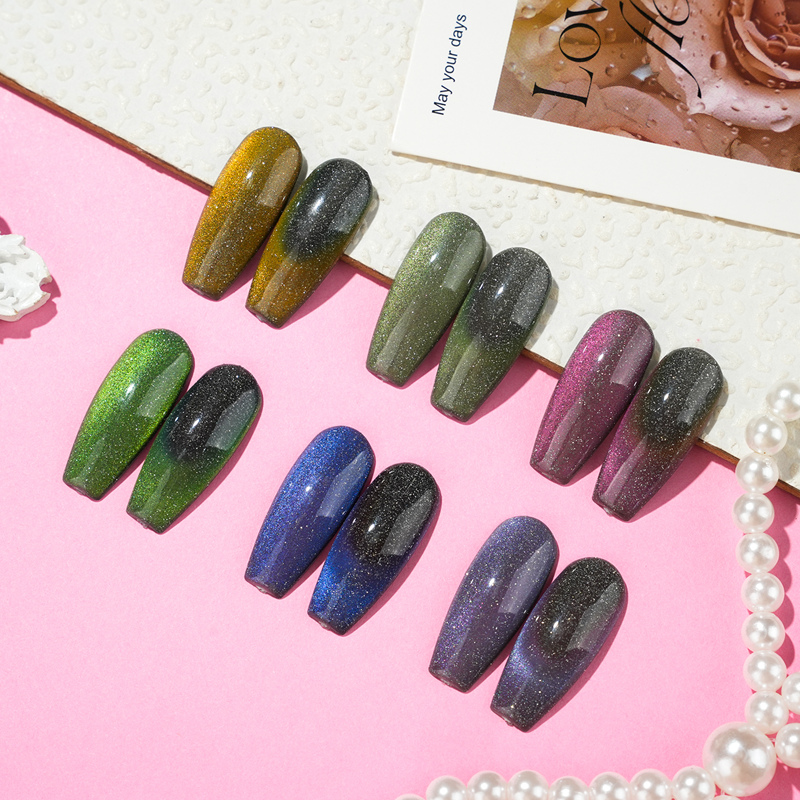
Magnetic gel is likely to remain one of the strongest finish categories because it creates multiple visual outcomes from one bottle. A narrow magnet can produce a cat-eye line; a broader or differently oriented tool can create a velvet-like glow. The value for salons is operational: one base color may support several nail-art looks without adding hand-painted detail.
However, the finish is difficult to standardize. Distributors should ask a gel polish manufacturer for:
A practical acceptance test is to apply the product in a controlled 0.10 to 0.15 mm layer, hold the magnet at a consistent distance, cure under the recommended lamp, and compare the effect after 7, 14, and 21 days. If the particles settle rapidly, the color separates in the bottle, or the line becomes dull under top coat, the formula needs improvement before mass distribution.
Chrome and liquid-metal effects will continue to attract buyers because they create a high-contrast result on short, medium, and sculpted nails. The finish is usually created through a combination of a smooth cured surface, chrome powder or reflective pigment, and a compatible top coat. The underlying surface matters: microscopic texture, residual inhibition layer, or an incompatible top coat can make the result appear gray instead of reflective.
Brands should prepare separate protocols for:
Do not market every reflective product as “mirror chrome.” A more credible product card can state the visible result under defined conditions, such as “silver reflection under direct LED light” or “micro-glitter flash effect under camera flash.” This wording reduces disappointment and helps distributors segment products by actual performance.
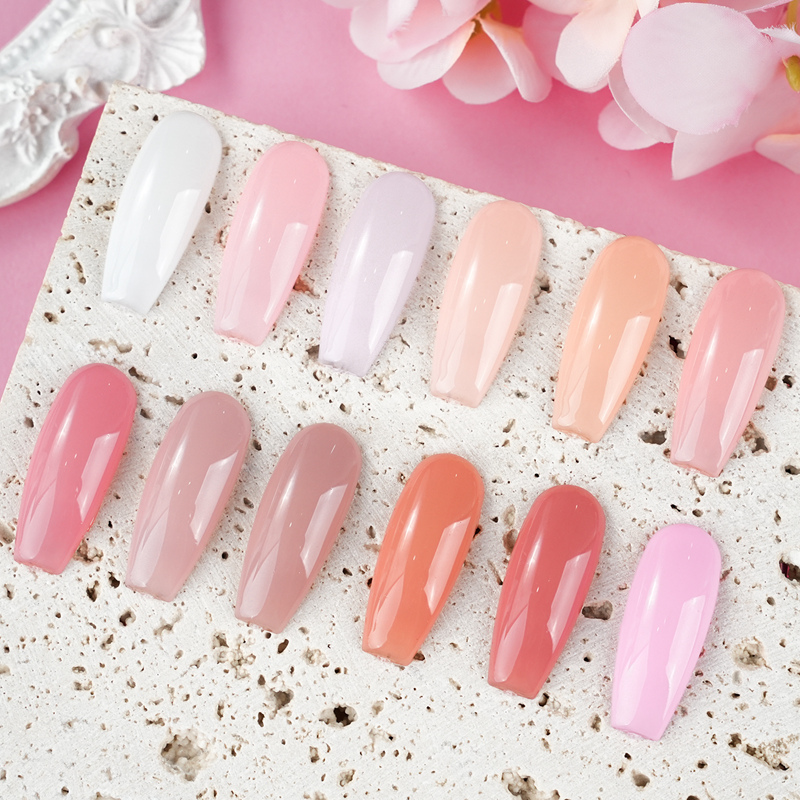
Sheer jelly gel polish answers a common salon problem: clients want natural-looking nails with a polished color veil rather than opaque coverage. Jelly finishes are also useful for layering. A sheer pink can be applied alone, over chrome, over glitter, or between a base color and a top effect.
The key technical risk is uneven coverage. Manufacturers should test transparency at one, two, and three coats and record the appearance over at least three base shades: natural nail, white, and dark color. A useful technical specification could state:
Sheer formulas also require controlled viscosity. If the material runs toward the sidewall before curing, the salon may spend more time correcting the application. If it is too thick, the finish may show ridges and cure inconsistently. A gel polish manufacturer should provide a recommended layer thickness and a cure schedule validated with the exact lamp model or wavelength range.
Pearl and opal effects are positioned between classic polish and full nail art. They can deliver a clean result for conservative clients while still appearing different in photographs. Color-shifting finishes may reflect pink, green, blue, or gold depending on the viewing angle and light source.
For distributors, the main challenge is accurate merchandising. A swatch photographed under a strong studio light may not match a salon illuminated by warm indoor bulbs. Product pages should show at least two lighting conditions and identify whether the color shift is caused by interference pigment, reflective particle, or a layered top-coat system.
Manufacturers should monitor pigment sedimentation, because larger effect particles can settle during storage. Stability testing should compare samples at room temperature and under accelerated conditions, then check color uniformity, viscosity, odor, and brush pickup. A product should not be called stable merely because it looks acceptable immediately after filling.
Matte finishes are evolving from a single flat surface into combinations such as matte base with glossy detail, satin nude with metallic line work, and velvet color with a glossy French tip. These combinations help salons create premium-looking designs without using many additional colors.
The most important purchase question is durability. A matte top coat should be assessed after exposure to hand washing, alcohol-based products, oil, and friction. Brands should report the testing method rather than promising “non-scratch” performance without evidence. A useful internal benchmark is to inspect gloss change and visible scuffing after 50 or more standardized rubbing cycles, then repeat the assessment after immersion in water and detergent solution.
Salon owners should evaluate a finish according to the complete service process, not the bottle appearance. Before placing a large order, request samples and test:
Ask the supplier to disclose whether the product is intended for professional use, what lamp settings are required, and which base and top coats have been tested together. A lower purchase price can become expensive if a salon experiences rework, client complaints, or inconsistent curing.
Distributors should avoid buying every finish in every shade before demand is established. A staged assortment is more resilient:
Inventory decisions should use sell-through data. For example, if 70% of a 12-shade test collection sells within the first 90 days but three shades account for 45% of units, the next purchase can increase depth in those three shades instead of repeating equal quantities across the entire range. The exact threshold will vary by channel, but the principle is measurable allocation rather than subjective color forecasting.
A gel system is a chemically reactive coating. Its performance depends on the balance between monomers, oligomers, photoinitiators, pigments, additives, and curing energy. Increasing pigment loading may improve opacity but reduce light penetration. Reducing viscosity may improve leveling but increase flooding. Adding effect particles may change both settling behavior and cure depth.
Before launch, test each finish under realistic conditions:
Manufacturers should never instruct users to compensate for incomplete curing by extending exposure indefinitely. If a formula does not cure reliably under its validated conditions, the product, lamp, layer thickness, or system compatibility needs to be investigated.
Brands should review HEMA and other acrylate-related ingredients carefully because sensitization is a significant professional concern. The presence or absence of one ingredient does not by itself prove that a product is safe for every person. Correct application, avoidance of skin contact, complete curing, and professional handling remain important.
For each market, prepare:
In the European Union, the TPO restriction is a particularly important example of why compliance must be checked at formula level. A distributor should verify the current legal status of every ingredient in the destination market and obtain an updated declaration from the supplier before reordering.
Interview salon owners, nail technicians, educators, and end users. Ask specific questions: Which finishes generate repeat bookings? Which products cause the most rework? How long does removal take? Which lamp models are in use? Are clients requesting low-maintenance natural looks, reflective effects, or customized nail art?
Separate preference from behavior. A client may say she likes chrome but select sheer pink for most appointments. Sales records, service menus, and reorder frequency provide more reliable evidence than trend images alone.
Request a structured sample kit rather than random colors. Include one formula from each finish category and ask for the technical specification. Test each shade on natural nails and extensions, under the same lamp, with the same base and top coats. Photograph the results in daylight, salon lighting, and flash.
Record measurable outcomes in a comparison sheet:
| Test area | Suggested record | Reason |
|---|---|---|
| Application | Number of coats, leveling time, flooding incidents | Predicts service speed and technician rework |
| Curing | Lamp, wavelength if available, cure time, heat sensation | Reduces under-curing and compatibility problems |
| Appearance | Gloss, opacity, effect intensity, color under three lights | Creates accurate product merchandising |
| Wear | Condition at days 7, 14, and 21 | Supports realistic wear claims |
| Removal | Removal method and elapsed time | Protects service efficiency and nail condition |
Effect products require better education than standard cream colors. Include diagrams showing magnet position, recommended layer thickness, curing sequence, and top-coat compatibility. For chrome products, explain the required surface condition. For jelly products, show one-, two-, and three-coat results.
Packaging should also reduce operational errors. Use clear finish names such as “Magnetic Velvet,” “Sheer Jelly,” “Pearl Shift,” or “Soft Matte,” and add a short technical descriptor. Avoid vague claims such as “ultimate,” “instant,” or “zero damage” unless the company can define and substantiate them.
Launch the collection with a controlled group of salons or distributors. Track sample-to-order conversion, repeat purchase rate, average units per salon, complaint type, and shade-level sell-through. Review the first 30, 60, and 90 days before committing to a large production run.
A useful decision rule is to keep a product when it combines strong repeat ordering with acceptable service results. A finish that sells once because of novelty but produces curing or removal complaints should not be expanded without reformulation or clearer instructions.
By 2027, the strongest gel polish portfolios will probably not be the ones with the largest shade count. They will be the portfolios that connect finish innovation with measurable salon performance. Brands should prioritize a tested magnetic system, a reliable chrome or reflective option, a flexible sheer collection, a refined pearl or opal group, and a durable matte or satin top-coat system.
Before placing production orders, confirm five essentials: formula compliance in every destination market, lamp and cure validation, wear and removal data, accurate finish photography, and a practical education kit. Ask a gel polish manufacturer to provide batch-level documentation and to support pilot testing rather than relying only on a catalog presentation.
The commercial opportunity is clear: salons want visual variety without slower services, distributors want products that reorder rather than stagnate, and consumers want distinctive nails that remain wearable. A finish-led product strategy from ISAYNAIL or another qualified supplier can meet those needs when optical effects, formulation science, compliance, and daily salon workflow are planned together.
Final takeaway: Prepare for 2027 by testing the complete product experience now—from bottle stability and photoinitiator balance to application, curing, wear, removal, education, and reorder data. The most valuable 2027 gel polish finish trends will be the ones that deliver a measurable result at the salon table, not merely an attractive claim on the label.
Related Products
Nail Art Beauty, Nail Salon, Nail SPA, or Training
Nail Art Beauty, Nail Salon, Nail SPA, or Training
Nail Art Beauty, Nail Salon, Nail SPA, or Training
Nail Art Beauty, Nail Salon, Nail SPA, or Training
Nail Art Beauty, Nail Salon, Nail SPA, or Training
Nail Art Beauty, Nail Salon, Nail SPA, or Training

You can trust us to deliver the best nail products in the market
10 years experience manufacture
Navigation
Navigation
Contact Us
+86 156 2229 8411
802, No. 75, Hanxing Middle Road, Zhongcun Street, Panyu District, Guangzhou City, Guangdong Province, China